
One of the first decisions MFA graduates face isn’t about the work — it’s about where to live. Staying in the city where you went to school, moving to New York or LA, choosing somewhere cheaper and less crowded: each option has real consequences for how the next few years of your practice develop. The best cities for emerging artists in the US aren’t the same for every artist, and the choice matters more than it’s usually treated.
Where you live shapes which galleries you can realistically build relationships with, what kind of studio space you can afford, how much time you spend working versus earning rent money, and what kind of artist community surrounds you. This guide compares the major options for MFA graduates — using four criteria: cost of living, gallery access, studio affordability, and income opportunities. The Alliance of Artists Communities also maintains a useful database of residency and support programs by city, which can inform location decisions alongside the factors covered here.
Table of Contents
- What Matters Most After the MFA
- New York City
- Los Angeles
- Chicago
- Detroit
- Philadelphia
- Pittsburgh
- City Comparison at a Glance
- Frequently Asked Questions
What Matters Most After the MFA
Before comparing cities, it helps to clarify what you’re actually optimizing for. The best cities for emerging artists in the US look different depending on which of these factors matters most right now.
Gallery Access
Building gallery relationships, participating in group shows, meeting curators — if this is the immediate priority, proximity to a major gallery scene matters. New York and LA lead here by a significant margin.
Cost of Living and Studio Affordability
The lower your fixed monthly costs, the less time you spend working jobs unrelated to your practice. A cheaper city doesn’t mean fewer opportunities — it often means more time in the studio. For many artists, this is the factor that determines whether the work continues at all. For a detailed breakdown of what New York specifically costs, the NYC cost of living guide for art students covers the real monthly numbers.
Artist Community
The critique culture and peer community that the MFA provides disappears the day you graduate. Cities with active artist communities — through residencies, open studios, artist-run spaces, and informal networks — help fill that gap. This matters especially in the first year or two after graduation.
Income Opportunities
Teaching artist positions, adjunct professorships, gallery assistant roles, art handling, museum education — how much of this exists in a given city affects how close your income source is to your actual practice. Cities with larger arts ecosystems tend to have more of these roles available, though they’re competitive everywhere.

New York City
New York is the default destination for MFA graduates and, for certain kinds of artists at certain moments in their careers, genuinely the right choice. The concentration of galleries, institutions, collectors, curators, and working artists is unmatched anywhere in the US. For artists whose primary goal is building gallery relationships, New York remains among the best cities for emerging artists in the US in terms of sheer access.
The honest counterpoint: New York is also where financial pressure most consistently competes with studio time. Rent, studio costs, and general expenses add up quickly, and many artists find themselves spending more energy on survival logistics than on work.
Gallery Scene
World-class. Chelsea, TriBeCa, Bushwick, and the Lower East Side each offer a different register of gallery — from major international spaces to experimental artist-run venues. The range of programming means there’s a relevant context for almost any kind of practice. For more on the neighborhoods worth knowing beyond Chelsea, the guide to New York galleries outside Chelsea covers the city’s broader gallery landscape.
Cost of Living and Studio
Among the highest in the US. A one-bedroom apartment in Brooklyn runs $2,500–$3,500 per month or more. Studio space in Bushwick, Ridgewood, Harlem, and parts of the Bronx is more affordable than Manhattan but still significantly higher than most other US cities — typically $800–$2,000 per month for dedicated studio space. Shared studio arrangements bring costs down but introduce their own constraints.
Income Opportunities
Abundant. Art handling, gallery assistant roles, art fair staffing, museum education, adjunct teaching, and arts administration positions all exist in greater numbers in New York than anywhere else. The competition for these roles is also higher, but the overall supply is greater.
Who It Works For
Artists whose primary immediate goal is gallery access and professional network building. Artists who can manage financial pressure without it affecting the work. Artists whose practice is in direct dialogue with urban life, art history, or the commercial gallery world.
Los Angeles
Los Angeles has become one of the core cities of US contemporary art — not as a challenger to New York but as a genuinely different kind of art world. The city’s scale, its connection to film and media industries, and its relatively more affordable studio space make it particularly well-suited to artists working at large scale or with moving image, performance, and time-based media.
Gallery Scene
The second-strongest in the US. Major galleries including Hauser & Wirth, Gagosian, and David Kordansky have significant LA presences. The emerging scene has shifted in recent years — Culver City and Downtown LA remain relevant, while Chinatown and Highland Park have become increasingly central to the contemporary emerging artist conversation. East LA is also worth watching for artist-run activity.
Cost of Living and Studio
Lower than New York, though the gap has narrowed significantly in recent years. One-bedroom apartments typically run $2,000–$3,000 per month. Studio space is a genuine advantage over New York — larger spaces at lower per-square-foot costs are much more accessible, particularly for artists working at installation scale or with fabrication processes that require room.
Practical Note on Transportation
A car is functionally necessary in LA. This is both a cost and a logistical reality that shapes how artists experience the city — the distance between neighborhoods that are all relevant to the art scene means that without a car, the city becomes much smaller.
Who It Works For
Artists working in video, film, large-scale installation, and performance. Artists interested in connections to entertainment and media industries. Artists who need more physical space than New York typically allows and who are comfortable navigating a car-dependent city.
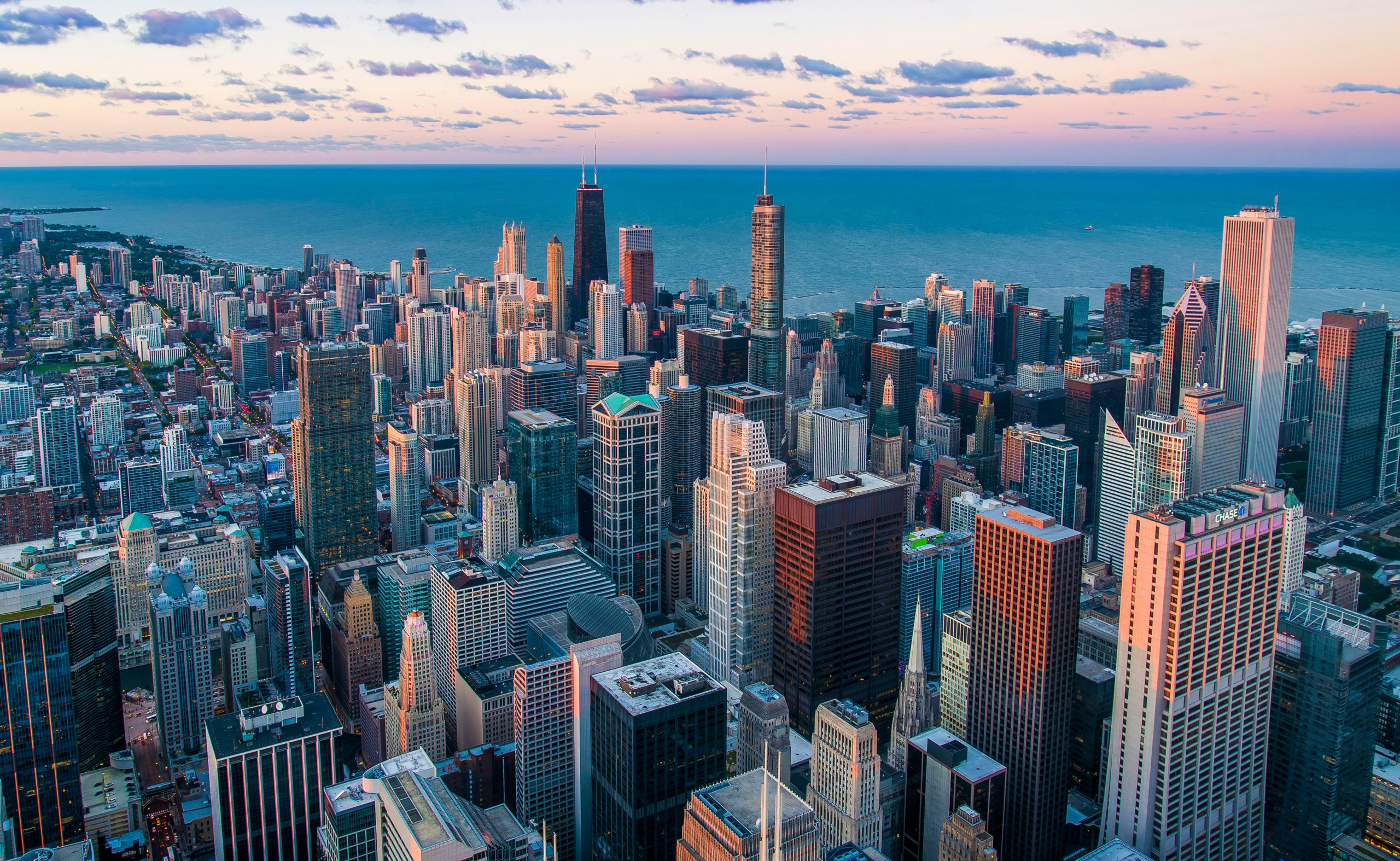
Chicago
Chicago is one of the most consistently underestimated cities for emerging artists — which, in practice, means less competition and more room. Among the best cities for emerging artists in the US, Chicago offers a rare combination: the cost of living is significantly lower than New York or LA, the artist community is active and genuinely supportive, and the institutional landscape — the Art Institute, MCA Chicago, the Museum of Contemporary Photography — is world-class. The Chicago Department of Cultural Affairs also runs funding programs and resources specifically for Chicago-based artists.
Gallery Scene
Smaller than New York or LA, but with real character. Corbett vs. Dempsey, Kavi Gupta, Rhona Hoffman Gallery, and a cluster of artist-run spaces give Chicago a gallery scene that’s more independent in character than commercially driven. New York galleries regularly pay attention to Chicago artists, and the two-hour flight between the cities makes maintaining connections in both directions manageable.
Cost of Living and Studio
One of the most realistic cost profiles among major US cities. One-bedroom apartments in artist-adjacent neighborhoods — Pilsen, Humboldt Park, Logan Square, Hyde Park — run $1,200–$1,800 per month. Studio space is available in the $400–$800 range, and shared studio situations bring costs lower still.
Artist Community
One of Chicago’s genuine strengths. The ecosystem around SAIC, UIC, Columbia College, and the University of Chicago’s arts programs sustains an active peer community for working artists. The post-MFA isolation that hits many graduates hard is less severe in Chicago than in cities with thinner artist communities.
Income Opportunities
Museum education at MCA Chicago and the Art Institute, occasional adjunct positions at area art schools, gallery assistant roles, and art handling. Because the cost of living is lower, the amount of income needed to sustain a practice is also lower — which changes the calculation meaningfully.
Who It Works For
Artists who want to focus on the work without the financial pressure of New York or LA. Artists who benefit from a genuine peer community. Artists who can build a strong local practice and use that as a foundation for engaging with larger markets over time.
Detroit
Detroit has become an increasingly important city for artists seeking affordable space and time — and one of the best cities for emerging artists in the US who prioritize studio scale over gallery proximity. The combination of extremely low costs, abundant large-scale studio space, and a city whose context is itself generative for certain kinds of practice has drawn a meaningful number of serious artists over the past decade.
Gallery Scene
Smaller than Chicago, but growing. N’Namdi Contemporary and Library Street Collective are among the more established spaces; a cluster of artist-run venues adds to the picture. The scene’s scale means that maintaining relationships with galleries in Chicago, New York, or elsewhere requires intentional effort — Detroit doesn’t substitute for those connections, but it doesn’t prevent them either.
Cost of Living and Studio
Among the lowest of any major US city. One-bedroom apartments in artist-active neighborhoods run $700–$1,200 per month. Large studio spaces in former industrial buildings — the kind of space that would be prohibitively expensive in New York or LA — are available for $200–$500 per month. For artists whose work requires physical scale, this is a genuine and rare advantage.
Who It Works For
Artists whose primary need right now is space, time, and financial breathing room. Artists working in large-scale installation, sculpture, fabrication, or public art. Artists whose practice is in dialogue with urban transformation, community, or post-industrial contexts — Detroit’s own situation makes it a generative environment for this kind of work.
Philadelphia
Philadelphia’s most important asset for emerging artists is geographic: it’s 90 minutes from New York by train. This proximity makes a specific strategy possible — living in Philadelphia at Philadelphia costs while maintaining regular access to the New York gallery scene. A meaningful number of working artists use exactly this approach, attending New York openings and meetings while keeping a studio and life in Philadelphia.
Gallery Scene
Philadelphia has its own active gallery scene, weighted toward independent and experimental spaces. The Philadelphia Museum of Art and the Institute of Contemporary Art (ICA) at Penn are the major institutional presences. New York galleries increasingly pay attention to Philadelphia artists, partly because of the city’s proximity and partly because of a track record of strong work emerging from the community.
Cost of Living and Studio
Significantly more affordable than New York. One-bedroom apartments in Kensington, Germantown, and West Philadelphia — areas with active artist communities — run $1,200–$1,800 per month. Studio space is typically $300–$700, with shared arrangements available at lower cost.
Artist Community
Tyler School of Art at Temple University and other regional art programs continue to support an active local artist ecosystem. The community tends to be less hierarchical and more accessible than New York’s, which some artists find more conducive to sustained work.
Who It Works For
Artists who want New York gallery access without New York costs. Artists who need studio space that New York can’t provide at a reasonable price. Artists who are willing to treat regular New York trips as part of their professional practice rather than their daily life.
Pittsburgh
Pittsburgh offers a combination that’s rare among US cities: very low cost of living, a strong institutional base anchored by Carnegie Mellon University and the University of Pittsburgh, and a genuine art scene that punches above its size. The Andy Warhol Museum, Carnegie Museum of Art, and Miller ICA at CMU give Pittsburgh a more serious institutional profile than most cities of its scale.
Cost of Living and Studio
Very low. One-bedroom apartments run $900–$1,400 per month. Studio space is typically $200–$500. The combination of university presence and low costs means that artists can often sustain a practice with significantly less income than would be required in major coastal cities.
Income Opportunities
CMU and the University of Pittsburgh generate occasional adjunct and university-affiliated opportunities for artists, though the adjunct market is competitive and limited everywhere. Museum education at Carnegie and the Warhol, art handling, and arts administration roles also exist within the city’s institutional ecosystem.
Who It Works For
Artists who want to work seriously with minimal financial pressure. Artists interested in university-adjacent opportunities for teaching or research. Artists drawn to a city where being a serious artist carries genuine cultural weight within a smaller, more legible community.

City Comparison at a Glance
| City | Cost of Living | Gallery Scene | Studio Cost | Community | Best For |
|---|---|---|---|---|---|
| New York | Very high | Strongest in US | High | Large, competitive | Gallery network |
| Los Angeles | High | Very strong | Medium | Large, dispersed | Media, large-scale work |
| Chicago | Medium | Strong, independent | Medium–Low | Strong community | Balance and stability |
| Detroit | Very low | Growing | Very low | Small, cohesive | Space and focus |
| Philadelphia | Medium–Low | Independent | Low | Accessible | NYC proximity strategy |
| Pittsburgh | Low | Institution-anchored | Low | University-adjacent | Teaching + practice |
Frequently Asked Questions
Q1. Do MFA graduates need to move to New York?
No — and the assumption that they do has led many artists into financial situations that work against the practice rather than for it. New York offers more gallery access than anywhere else in the US, but gallery access isn’t the only variable that determines whether an artist’s career develops. If financial pressure consistently takes time away from the studio, a less expensive city may produce better outcomes over five years than New York does. For guidance on how to build gallery relationships from wherever you’re based, the guide to approaching galleries professionally covers the process in detail.
Q2. Can you maintain gallery relationships from a cheaper city?
Yes, and many artists do. The Philadelphia-to-New York strategy is perhaps the most legible version of this — regular train trips to attend openings and meetings while maintaining a studio in Philadelphia. Detroit-to-Chicago and Pittsburgh-to-New York work on similar logic. What’s required is intentionality: the connections don’t maintain themselves, but they don’t require living in the city to sustain.
Q3. Which cities have the most teaching opportunities?
Cities with higher concentrations of art schools and universities. Chicago (SAIC, UIC, Columbia College), Pittsburgh (CMU, Pitt), and Philadelphia (Tyler School of Art) generate more teaching-adjacent opportunities than cities with smaller university presences. New York and LA also have these roles but with significantly more competition. The adjunct market is genuinely limited everywhere — these opportunities exist, but shouldn’t be assumed. For guidance on building a CV that makes teaching applications stronger, the artist CV guide covers professional presentation at every career stage.
Q4. What about international artists after their MFA?
Visa status affects city choice in ways that don’t apply to domestic graduates. OPT authorization tied to a US institution may influence where you can work legally in the post-MFA period. New York has the largest range of arts employment options, which matters for OPT purposes. For more on post-graduation work authorization options, the OPT guide for international art school graduates covers the specifics.
Q5. Is it worth moving cities after a few years?
Often yes. Many artists spend the first one to three years after the MFA in a lower-cost city — building a body of work, developing a practice, establishing a CV — and then move to New York or LA when they have the portfolio and connections to engage that scene productively. Cities aren’t permanent. The question is which city serves the practice best at a specific moment in its development.
Final Thoughts
The best cities for emerging artists in the US aren’t the most famous ones — they’re the ones that match what a specific practice needs at a specific moment. That might be New York’s gallery density, or it might be Detroit’s studio space and financial breathing room, or Philadelphia’s proximity to New York at Philadelphia costs.
The most useful question isn’t “where should an emerging artist live?” It’s “what does my practice need right now, and which city creates the best conditions for that?” The city is a tool. Choose it accordingly.