
Understanding how much does an MFA cost is the first step every applicant needs to take before applying. When people start researching MFA programs, tuition is usually the first number they look at. It’s also usually the most misleading one. In reality, tuition is often only half of what you actually spend. Many applicants underestimate how quickly costs add up once they factor in living expenses, materials, health insurance, and the cost of moving to cities like New York or Los Angeles. For many applicants, the real question sn’t whether they can get in — it’s whether they can afford to go. This guide breaks down what an MFA actually costs in 2026 — every category, not just the headline number.
Tuition — The Number That Varies Most
When thinking about how much does an MFA cost, tuition is the number that varies most. Private art schools and universities — Yale, Columbia, NYU, Parsons, SVA — typically charge between $40,000 and $60,000 per year. Over a two-year program, tuition alone can reach $80,000 to $120,000 before anything else is added.
Public universities are considerably more affordable. Out-of-state students typically pay $15,000 to $30,000 per year, and in-state residents often pay significantly less. Programs at schools like the University of Illinois, Ohio State, or the University of Colorado can cost a fraction of what private programs charge for a comparable education.
Then there are fully funded programs — and these change the calculation entirely. Some MFA programs offer admitted students a full tuition waiver plus a teaching assistantship stipend of $1,500 to $2,500 per month. Competition is intense, but for artists who qualify, the financial reality looks completely different.
Cost of Living — The Variable Nobody Budgets for Carefully Enough
Where you study matters as much as where you study. Many applicants underestimate how quickly costs add up once they move to cities like New York, where a one-bedroom apartment regularly runs $2,500 to $3,500 per month. Add food, transportation, and everyday expenses, and a realistic monthly budget in New York is $4,000 to $5,000. Over two years, living costs alone can reach $100,000 or more.
Chicago and Boston are somewhat more manageable, but still expensive. Cities in the Midwest and South — where many strong public MFA programs are located — tell a very different story. Monthly living costs of $1,500 to $2,000 are realistic in places like Columbus, Champaign, or Albuquerque, which means the total cost of attendance can be cut dramatically just by choosing a different location.
Materials and Studio Costs
Materials are one of the most consistently underestimated expenses in an MFA program. Depending on your medium, expect to spend $500 to $2,000 per semester on supplies alone. Sculpture, installation, and video work tend to run higher. Painting and drawing programs have lower per-semester costs, but those costs are recurring throughout the program.
Some programs charge separate studio fees. Others include studio access in tuition. It’s worth asking specifically — the difference can add up to several thousand dollars over two years. Budget $2,000 to $8,000 for materials across the full program, depending on your practice.
Application Costs
The application process itself carries a real cost that many people overlook. Application fees typically run $75 to $120 per school. Applying to 10 to 15 programs — which is common for competitive applicants — means $750 to $1,800 in fees alone.
Add portfolio printing and shipping, official transcripts, TOEFL registration for international students, and any professional portfolio review services, and the total cost of applying to MFA programs can easily reach $2,000 to $3,000.
Visa and Relocation Costs for International Students
For international applicants, F-1 visa costs add another layer. The SEVIS fee is $350, the visa application fee is $185, and document preparation — translations, notarizations, and courier fees — adds several hundred dollars more. Total visa-related costs typically fall between $600 and $800.
First-year relocation expenses — flights, initial furniture, a security deposit, and basic household setup — add another $3,000 to $5,000 on top of that. These are one-time costs, but they hit at the worst possible time: before any stipends or financial aid have begun.
Health Insurance
Health insurance is mandatory at most US universities, and it’s not cheap. School-provided plans typically cost $2,000 to $4,000 per year. Some funded programs include health insurance as part of the package — this is worth confirming before accepting any offer, since it can make a meaningful difference in your actual cost of attendance. Taken together, these expenses explain why understanding how much does an MFA cost requires looking beyond the tuition page alone.
Total Cost Breakdown Summary
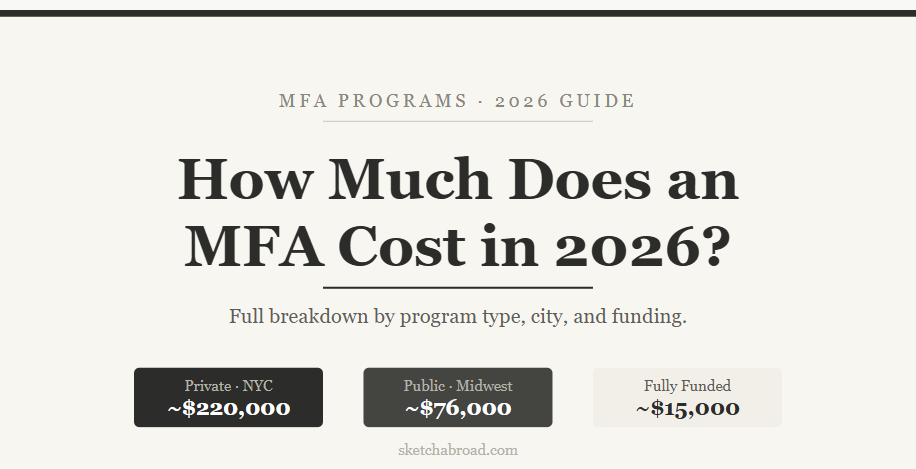
Before diving into the numbers, it helps to understand how much does an MFA cost across different program types — the range is wider than most applicants expect. Here’s what the numbers actually look like across three realistic scenarios:
- Private school in New York, no funding: ~$220,000
- Public university in the Midwest, partial funding: ~$76,000
- Fully funded program: ~$10,000–$20,000
The difference between these scenarios isn’t marginal — it’s the difference between starting your career with six figures of debt or starting it close to debt-free.
How Much Does an MFA Cost — Real Scenarios Explained
Scenario 1 — Private school in New York, no funding: Tuition $100,000 + living costs $110,000 + materials $5,000 + other $5,000 = approximately $220,000 total.
Scenario 2 — Public university in the Midwest, partial funding: Tuition after aid $30,000 + living costs $40,000 + materials $3,000 + other $3,000 = approximately $76,000 total.
Scenario 3 — Fully funded program: Tuition $0 + monthly stipend covers most living costs + out-of-pocket materials and extras = approximately $10,000 to $20,000 total.
Which Type of Program Fits Your Situation?
If you prioritize prestige and industry connections → Private programs in major cities offer stronger alumni networks and more direct access to galleries, collectors, and the broader art world. The cost is real, but so is the access.
If you prioritize cost efficiency → Public universities with strong programs offer serious MFA training at a fraction of the price. Combine this with a lower cost-of-living city and the financial picture changes significantly.
If your goal is zero debt → Fully funded programs are the only reliable path. Build your application list around programs known for funding their students, and treat unfunded private schools as a secondary option rather than a default.
The Biggest Mistakes Applicants Make
Only comparing tuition numbers: Tuition is the starting point, not the full picture. Two programs with similar tuition can have total costs that differ by $50,000 or more once location is factored in. Always calculate total cost of attendance, not just the headline figure.
Ignoring cost of living entirely: Living in New York or Los Angeles adds $30,000 to $50,000 to your total costs compared to a mid-sized city — sometimes more. This single variable can matter more than tuition when comparing programs.
Not seriously pursuing funding: Many applicants apply to funded programs but treat them as long shots and don’t invest enough in those applications. Funded offers go to people who make a strong, specific case for why they belong in that program. Treating every application — funded or not — with the same level of care is the most financially important thing an MFA applicant can do.
Frequently Asked Questions About MFA Costs
What is the average cost of an MFA program in the US?
The average total cost of an MFA program — including tuition, living expenses, and materials — ranges from $60,000 to $220,000 depending on the school and location. Private programs in major cities represent the high end; funded public programs represent the low end.
Are there MFA programs that are fully funded?
Yes. A number of MFA programs offer full tuition waivers plus monthly stipends through teaching assistantships. These programs are highly competitive, but they exist across a range of disciplines including painting, sculpture, photography, and interdisciplinary art.
Is an MFA worth the cost?
It depends entirely on the program and how you use it. A funded MFA at a program with strong faculty and alumni connections can be genuinely career-defining. An unfunded MFA at a less connected program, financed entirely through loans, is a much harder case to make financially.
How do international students pay for MFA programs?
International students have access to the same funding opportunities as domestic students — teaching assistantships, merit scholarships, and need-based aid where available. Federal loans are not available to international students, which makes securing institutional funding even more important.
What is the cheapest way to get an MFA in the US?
The most cost-effective path is a fully funded program at a public university in a lower cost-of-living city. This combination can reduce total costs to $10,000 to $25,000 over two years — compared to $200,000 or more at an unfunded private program in a major city.
What No One Tells You About MFA Costs
There are a few things that rarely appear in program brochures but consistently catch students off guard once they arrive.
The first is the cost of critique. Many MFA programs expect students to print, frame, or professionally present work for critiques and thesis exhibitions. These production costs — which can run several hundred to several thousand dollars per semester depending on your medium — are almost never itemized in the official cost of attendance.
The second is the hidden cost of networking. Attending openings, artist talks, and industry events is considered part of the MFA experience, but travel, clothing, and event costs add up quickly — especially in cities like New York where the social calendar never stops.
The third is the opportunity cost of two years. An MFA is not just a financial investment — it’s a time investment. Two years out of the workforce, or two years of reduced income, is a real cost that doesn’t appear on any tuition page. For artists who were already earning from their practice, this calculation matters.
Understanding how much does an MFA cost means accounting for all of these factors — not just the number on the admissions website. The applicants who navigate MFA finances most successfully are the ones who go in with a complete picture, not just the headline figures.

Further Reading
If you’re weighing the financial side of your MFA decision, understanding what reviewers actually look for in applications can help you direct your energy where it matters most. This guide on the most common MFA interview questions and this overview of what makes a strong MFA portfolio are both worth reading before you finalize your application list.